Day 3

EMT Curriculum

Get started today.
1 of 6

    [acceptance* consent id:cf7-consent]

    Learn What to Expect on the Third Day of EMT Training

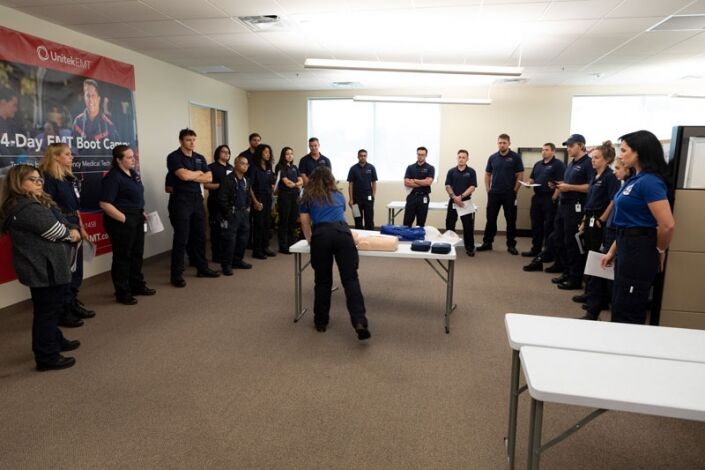
    The 14-day EMT Boot Camp includes interactive classroom instruction, hands-on exercises, and clinical simulations. Taught by experienced EMS professionals, the EMT program includes about 12 hours of EMS instruction per day for 14 consecutive days. During the program, students participate in realistic emergency simulations to prepare them for success in the field.

    Click here for an overview of the EMT Boot Camp Program. (If you’ve already earned your EMT license and need to recertify, click here to learn more about the Unitek EMT Refresher Course.)

    This guide is part of a 14-part series providing an overview of each training day at the Unitek 14-day EMT Boot Camp. This article summarizes Day 3.

    (Click here to explore our full 14-day EMT Curriculum)

    About the EMT Textbook

    The primary textbook for the EMT Boot Camp is: Emergency Care and Transportation of the Sick and Injured Digital Advantage Package, Twelfth Edition. Published by the American Academy of Orthopaedic Surgeons (AAOS), this textbook provides the fundamental knowledge of the emergency medical services (EMS) system, safety and well-being of the emergency medical technician (EMT), medical and legal, and ethical issues to the provision of emergency care. Each chapter covers National EMS Education Standard Competencies.

    Chapters Covered Include:

    • Chapter 10: Patient Assessment
    • Chapter 11: Airway Management
    • Chapter 13: Shock
    • Chapter 15

    EMT Textbook Chapter 10—Patient Assessment: Summary

    Chapter ten covers the application of scene information and patient assessment findings to the pre-hospital treatment of patients. This includes an in-depth discussion of scene size-up, primary and secondary assessment, patient history, and reassessment to guide emergency management.

    After completing this chapter and coursework, you will understand the scope of the patient assessment process for EMS patients and all phases and components of patient assessment. Please note that this chapter is divided into five sections: scene size-up, primary assessment, history taking, secondary assessment, and reassessment. These divisions will help facilitate your understanding of the patient assessment concept and process.

    EMT Textbook Chapter 11—Airway Management: Summary

    This chapter applies general anatomy and physiology knowledge to patient assessment and management to assure a patent (open and unobstructed) airway, adequate mechanical ventilation, and respiration for patients of all ages. This includes lessons on the respiratory system, breathing, respiration, patient assessment, opening and maintaining the airway, suctioning, supplemental oxygen, assisted and artificial ventilation, and more.

    This chapter will give you the understanding needed for proper airway management, including recognizing and measuring adequate and inadequate breathing, maintaining an open airway, and providing artificial ventilation. You will be able to apply these concepts to appropriate care through the use of airway adjuncts, suction equipment, oxygen equipment and delivery systems, pulse oximetry, continuous positive airway pressure (CPAP), and resuscitation devices.


    EMT Textbook Chapter 13—Shock: Summary

    Chapter 13 covers the causes, effects, and management of shock, respiratory failure or arrest, cardiac failure or arrest, and post-resuscitation management. This includes an in-depth discussion of the various types of shock, their signs and symptoms, patient assessment for shock, and emergency care.

    After completing this chapter and course work, you will have an understanding of the different types and causes of shock, the process of perfusion, the signs and symptoms associated with shock, the application of the assessment process with the shock patient, and the general and specific emergency medical care provided to patients experiencing shock.

    EMT Textbook Chapter 15: Homework

    Day 3: Summary

    After successfully completing Day 3 of the EMT Boot Camp, you will have a thorough understanding of how to assess patient conditions and how to stabilize and care for them based on your assessment. You will learn how to recognize and handle patients in shock. And, you will also feel confident after having learned and practiced techniques for airway management.

    Day 3 includes 12 hours of rigorous coursework and study. You will be expected to process a lot of information in a relatively short time. The Unitek 14-Day EMT Boot Camp is not easy, but it is worth it! Our dedicated graduates are among the best-trained and most effective EMTs in the world today. Click here to learn more about our two-week EMT Boot Camp.

    (Click here to explore our full 14-day EMT Curriculum)

    About Unitek EMT

    Unitek EMT is one of the premier EMT schools in Arizona. Our mission is simple: training the next wave of top-notch EMT professionals. We offer a variety of training options to fit your needs, including an accelerated EMT program to get you mission-ready and certified fast. We also offer EMS Continuing Education courses to update your expertise and enhance your career. Unitek EMT instructors are experienced leaders in their fields, and our real-world training scenarios are ideal for aspiring EMT professionals.

    Get started today!!

    Complete this form and our Admissions department will contact you shortly with more information..

      [ Image ]

      Latest News

      Female medical professional in a lab coat with her arms crossed
      EMS
      August 29, 2025 Alyssa Jordan
      EMT to Doctor: How to Prepare For Medical School
      Read more
      Male ambulance driver using a radio
      EMS
      July 14, 2025 Alyssa Jordan
      How to Become an Ambulance Driver
      Read more
      An infographic comparing asynchronous vs. synchronous online learning styles. Asynchronous: self-paced, on-demand, balanced, independent, and anytime. Synchronous: scheduled, controlled, collaborative, interactive, and time-bound.
      EMS
      July 8, 2025 Enzo Pighini
      Asynchronous vs. Synchronous Learning: What’s the Difference and Which Is Right for You?
      Read more