Learn What to Expect on the Sixth Day of EMT Training
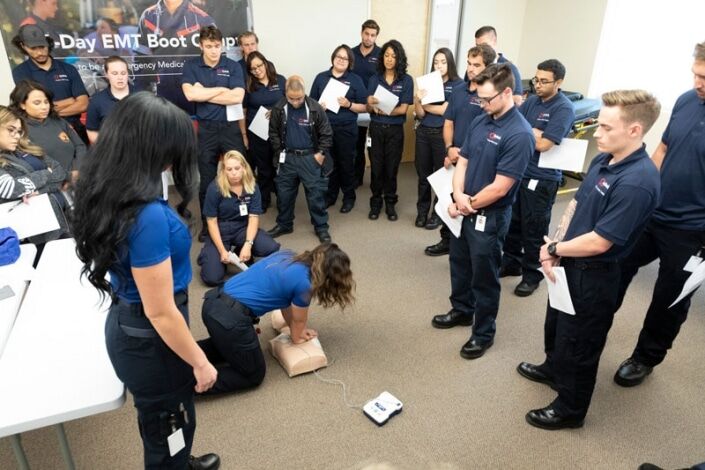
The 14-day EMT Boot Camp at Unitek EMT features interactive classroom instruction, hands-on exercises, and clinical simulations. The Boot Camp is taught by experienced EMS professionals and averages about 12 hours of EMS instruction per day for 14 consecutive days. During the program, students participate in realistic emergency simulations to prepare them for success in the field.
The textbook used throughout the EMT Boot Camp is: Emergency Care and Transportation of the Sick and Injured Digital Advantage Package, Twelfth Edition. Published by the American Academy of Orthopaedic Surgeons (AAOS), this textbook provides the fundamental knowledge of the emergency medical services (EMS) system, safety and well-being of the emergency medical technician (EMT), and medical, legal, and ethical issues relevant to emergency care. Each chapter covers National EMS Education Standard Competencies.
Chapters Covered on Day 6 Include:
Chapter 21: Allergy
Chapter 22: Toxicology
Chapter 23: Behavioral Emergencies
EMT Textbook Chapter 21—Allergy: Summary
Chapter 21 focuses on allergic emergencies, including hypersensitivity disorders and anaphylactic reactions. Students will learn the fundamentals needed to provide basic emergency care and transportation based on assessment findings for an acutely ill patient. This includes the recognition and management of shock and difficulty breathing related to anaphylactic reactions.
After completing Chapter 21, you will understand the anatomy, physiology, and pathophysiology of allergic reactions, hypersensitivity disorders, and anaphylactic reactions. You will also have the knowledge and skills needed to recognize and manage disorders and reactions.
After this chapter, students will know the difference between a local and systemic response to allergens and be able to identify the five categories of stimuli that could cause an allergic reaction. Students will also be prepared to manage the ABCs of a patient experiencing an allergic reaction.
EMT Textbook Chapter 22—Toxicology: Summary
Chapter 22 provides a foundational background on the basic emergency care and transportation of patients suffering from toxic exposure or poisoning. Subjects covered include:
Carbon monoxide poisoning
Nerve agent poisoning
Inhaled poisons
Ingested poisons
Injected poisons
Absorbed poisons
Alcohol intoxication and withdrawal
After completing this chapter and its coursework, you will be familiar with the classes of compounds involved in substance abuse and poisoning. You will also understand the routes by which poisons enter the body and the signs, symptoms, assessment, and treatment for various poisoning emergencies. You will understand the role of airway management for patients suffering from poisoning or overdose. Finally, chapter 21 also enables you to apply safety considerations for scenes with potentially hazardous materials or violent people.
Chapter 23 provides the necessary knowledge to provide basic emergency care and transportation for patients with behavioral & psychiatric emergencies, including acute psychosis, suicidal risk, and agitated delirium. The topics covered include:
The myths and realities of behavioral emergencies
Factors that can alter a patient’s behavior
The magnitude of mental & behavioral health problems in society
The main principles of the mental health care system
The two basic categories of behavioral health diagnosis
After completing this chapter, you will have the knowledge and skills to successfully assess and manage patients suffering from a psychiatric emergency within the legal parameters of the EMT scope of practice. The curriculum will familiarize you with the basic principles of the mental health system. You will know the signs of psychosis, schizophrenia, delirium, posttraumatic stress disorder (PTSD) and suicide. Additionally, you will be able to recognize behaviors that pose a risk to the EMT, patient, or others and the methods used to restrain patients.
Day 6: Summary
After successfully completing Day 6 of the EMT Boot Camp, you will possess important knowledge and skills for the prehospital treatment of allergic, toxicology, and psychiatric emergencies. You will understand the ETM treatment and transportation procedures for:
Allergic emergencies, including hypersensitivity disorders and anaphylactic reactions
Exposure to poison and other toxins, including substance abuse
Psychiatric conditions, including acute psychosis, schizophrenia, PTSD, and suicidal threat
Day 6 requires 12 hours of participation from start to finish, including two half-hour breaks for lunch and dinner. The coursework and training are accelerated. You will be expected to process and retain a lot of information in a relatively short time.
The Unitek 14-day EMT Boot Camp is not easy, but it is worth it! Our dedicated graduates are among the best-trained and most effective EMTs in the world today. Click here to learn more about our two-week EMT Boot Camp.
Unitek EMT is one of the premier EMT schools in Arizona. Our mission is simple: training the next wave of top-notch EMT professionals. We offer a variety of training options to fit your needs, including an accelerated EMT program to get you mission-ready and certified fast. We also offer EMS Continuing Education courses to update your expertise and enhance your career. Unitek EMT instructors are experienced leaders in their fields, and our real-world training scenarios are ideal for aspiring EMT professionals.
Get started today!!
Complete this form and our Admissions department will contact you shortly with more information..